Showing posts with label interest rates. Show all posts

Monday, 10 February 2014

Interest Rates and Employment: The Taper's Well Camouflaged

Protect Tapirs: http://www.tapirs.org

Tapirs are well-camouflaged. So's the taper: you have to look for it. That should not be surprising to anyone who lets their view of the world be affected by data, rather than the pop version of a simplistic model.

...the taper's well-camouflaged...

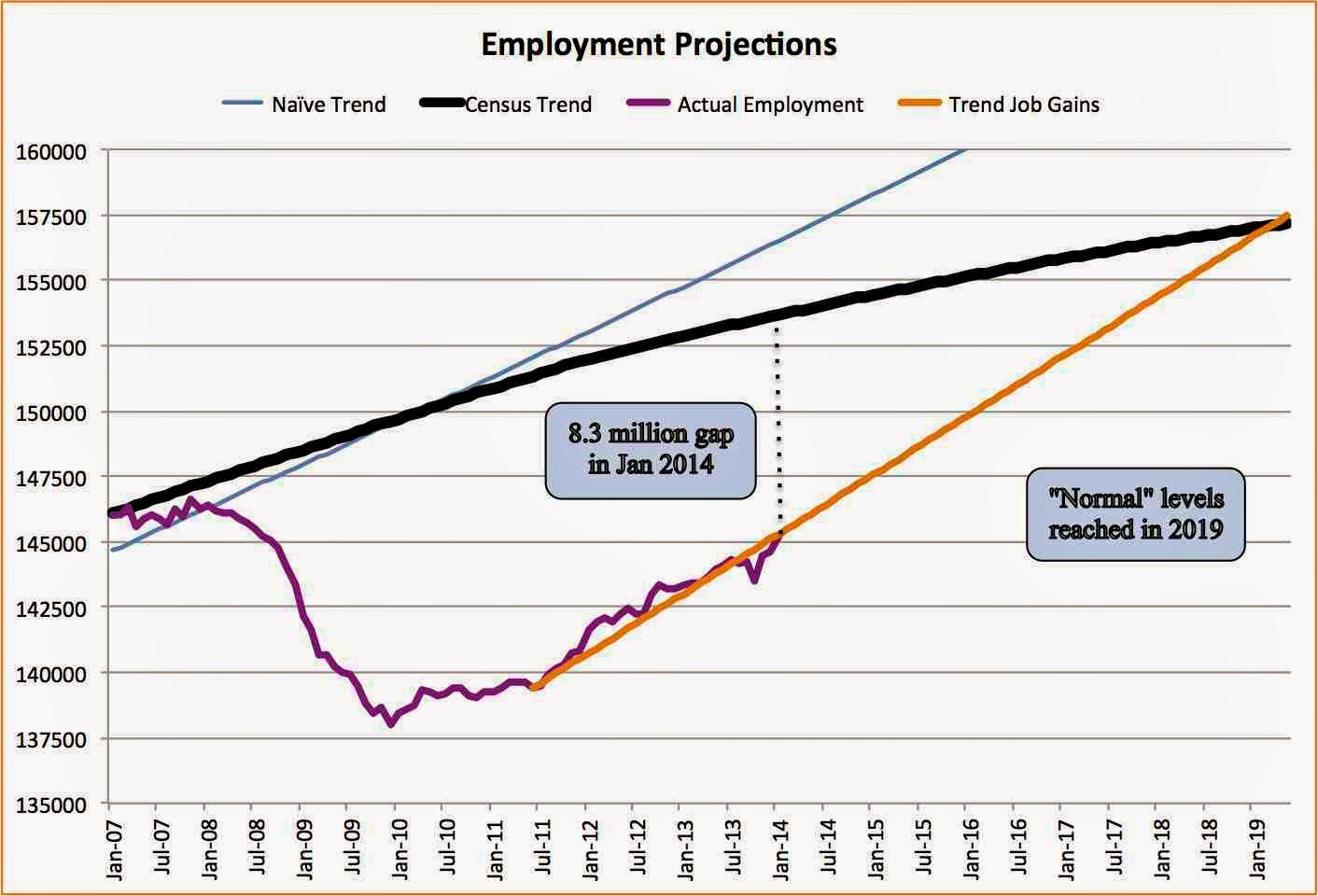
First, the data; I present 1 month, and 1-, 5-, 10- and 30-year interest rates, pulled from the Treasury's Daily Yield Curve web page. Interest rates are certainly up over the nadir of 2012, but casual reading of the graph suggests at best a modest impact (see the Wikipedia entry on the three US rounds of "quantitative easing", or the analysis of economist's such as that of James Bullard at the St. Louis Fed). In the background of course is the continued slow growth of the economy, which at its current pace of job creation will take until 2019 to bring us back to normal. Meanwhile, there are no signs of an uptick in inflation (and in Europe, a few whiffs of deflation).

This is of course in tension with the naive MV = PY monetarist frameword, most clearly developed by Irving Fisher but used as well by JM Keynes and Milton Friedman. In practice, given the ongoing evolution of financial systems around the globe, defining "money" and then measuring it is problematic, and "velocity" is volatile – and QE isn't directly affecting money, only providing an enabler for banks to create additional credit, and thus the bank deposits that we actually use. Meanwhile, at low levels of nominal GDP growth the split between prices and output is sufficiently uncertain that the conceptual link between money growth and prices is empirically useless – if somehow we overcome measurement errors in "M" and can predict V to give us a prediction of the growth of PY – nominal GDP – of 3%, we don't know whether we get real GDP of 3% and no inflation, or 3% inflation and no growth.
So there is no simple link between QE3 and growth. Indeed, there's no simple link with interest rates. At longer maturities interest rates reflect arbitrage opportunities: if we want to hold bonds through (say) 2019 we can for example choose between a 5-year bond and rolling over a series of 1-year bonds. What that tradeoff looks like thus reflects our expectations of future interest rates. If we expect slow growth to continue for most of the next 5 years, then we would expect the Fed to hold short-term interest rates to a low level, with or without QE3 – that is, whether we taper or not. If so, then a 5-year bond should carry an interest rate little different from today's short-term rate. If in 2018 we expect to be back to "normal" with 2% growth and 2% inflation, then we might think that come 2018 one-year rates could be around 4%. In that case 5-year rates (as an average of 1-year rates each year from now to then) would be lower than 4% – using annual rates of .1%, 1%, 2%, 4% and 4% gives a (compounded) 5-year return of 2.2% – but 10-year rates should be sharply higher (assuming rates after 2018 stay a constant 4% gives a 10-year return of 3.1%), and 30-year rates very close to 4% (keeping post-2018 rates at 4% would suggest 3.7%).

...the Fed may taper but interest rate's aren't going to move much...

Now the current rate of employment growth suggests that we won't be back to trend employment levels until 2019. Because of the retirement of the baby boomers employment growth need not be as stront as in the past (a naive projection gives the light blue line, 2.7 million above an estimated based on Census population projections and age-specific employment rates). Unfortunately we're still a long ways from normal. And guess what? My back-of-the-envelope calculations suggests interest rates are consistent with the employment story. The Fed may taper, but absent stronger growth, interest rates aren't going to move much.

...interest rates are consistent with employment growth (or its lack) rather than the taper

Mike Smitka

Friday, 29 November 2013

What’s With the Higher New Vehicle MSRPs?

Ruggles – AFN – Dec 2013
The price of new vehicles has been rising at a steady rate despite record auto manufacturer profits.  This has been accomplished by just raising the price, through added content to base vehicles, and reduced expenditure on incentives. What is driving this trend? I see no evidence of any real movement in manufacturing costs. Labor costs via the D3 UAW contract are locked in for the next few years. What’s the deal?
Many believe the industry is preparing for the inevitable interest rate rise which will most certainly begin as early as next spring. Providing we get through the next round of debt ceiling issues in Congress in one piece and the economy remains resilient, new Federal Reserve Chairman Janet Yellen and her Board of Governors will need to begin backing of the level of stimulus the Fed has poured into the economy. That means interest rates have to rise.
Our industry has been enjoying the longest span of low interest rates I’ve seen in over 40 years. Dealers are often in the position of being in a positive cash flow position on their floor plan account, receiving more from their OEM in floor plan subsidy than they pay out in interest to their floor plan lender. Many have been lulled into thinking this is the way it is supposed to be, and that it will continue. I don’t normally make predictions, but I can guarantee that this is NOT the case and it will NOT continue. Our industry needs to brace for more normal interest rates. I believe that is exactly what the OEMs are doing.
The higher MSRP prices mean OEMs are positioning themselves to be able to offer below market interest rate subventions in an attempt to maintain volume momentum in the face of the inevitable rate increases. While subventions will most certainly be offered through OEM captive finance arms, manufacturers might also need to offer enhanced incentives for those buyers the “captive” doesn’t want to finance, for either credit or advance reasons.
Regardless, the subventions will funnel more business to “captives” and away from independent banks and credit unions. We’ll also see continued growth in leasing through “captives” with significant money factor subventions. Independent lenders who lack OEM support need to prepare for the inevitable downturn in business.
Dealers need to prepare for a flattening out of vehicle sales traffic while consumers adjust to the new reality. Dealers also need to prepare for a rise in floor plan costs by watching their inventory levels more closely. This hasn’t been much of a problem given the recent balance between production and demand, but a flattening out of sales traffic could change that quickly.
The pre-owned side of the business will also be impacted. In particular, the Certified Pre-Owned business will see challenges. As real market interest rates increase, the payments on a Certified Pre-Owned vehicle will rise to where there won’t be enough difference between the subvented payment on a new vehicle and the non subvented payment on a CPO unit to warrant a consumer considering the CPO vehicle. OEMs who aren’t prepared to subvent on the CPO side of their business, and to offer residual based financing alternatives for consumers, could be in for a shock. As CPO sales slow and inventory backs up manufacturers could see a sudden decline in late model pre-owned values as dealers aren’t so eager to stock CPO inventory at the same level as they did in a market with the artificially low interest rates they have enjoyed for the last few years. Against this backdrop, there are hundreds of thousands of fresh lease returns scheduled to reenter the pre-owned market.
As ex Federal Reserve Chairman William McChesney Martin once famously said, “The job of the Federal Reserve is to take away the punch bowl just as the party gets going." This was in the context of raising interest rates just when the economy approaches peak activity after a recession. Given the long run of low interest rates and the dramatic increase in money supply through Federal Reserve Quantitative Easing, this axiom has never been more important.
The punchbowl is about to disappear and it’s time to prepare for it.

Sunday, 8 September 2013

Fed Tapering and Interest Rates

If Past is Prologue

Ruggles AFN September 2013

Federal Reserve Chairman Ben Bernanke let it slip a couple of months ago that the Fed might begin to “taper its asset purchases” this fall. “Asset purchases” in this case is a euphemism for the Federal Reserve buying our own U.S. Government debt. The Fed has been buying about $85 billion in U.S. Government bonds each month for quite some time, representing about 60% of total U. S. debt purchases. Yes, they do this by “printing money,” another euphemism.

Markets didn’t like the sound of Bernanke’s comment and immediately retreated, the Dow from a record high of over 15,000. Certainly, markets hang on every word Bernanke speaks, reacting to the actual words as well as to what they think he means. Bernanke says the Feds future actions will be “data driven.” Analysts believe the Fed could begin their “taper” as soon as September if data for August looks favorable.

Mortgage interest rates have risen a full percent this year. Despite this, home prices have advanced remarkably. The “Sequester Spending Cuts” are still in effect, adversely impacting GDP numbers, yet the economy marches forward showing surprising growth under the circumstances. The specter of another debt ceiling fight, as Republicans threaten to hold the debt ceiling hostage in an attempt to renegotiate ObamaCare, hangs like a pall over the economy while fears of a Syrian/Middle East engagement raises fears of a sudden spike on global oil prices putting the world economy in jeopardy. Still, the U.S. economy marches on. Many analysts believe this is a product of incredible built up demand in the U. S. economy.

Normally, “money printing” of this magnitude weakens a country’s currency, which occurred initially to the U. S.dollar. That had many folks upset, but resulted in an export boom led by refined fuels as dollar denominated trade became less expensive to foreign buyers. Another effect of a weaker dollar was that Chinese goods became more expensive here, resulting in the loss of about 10,000,000 jobs in China. Surprisingly the dollar has recently strengthened. Now Japanese and Korean auto manufacturers are feeling price pressure on exports to the U.S. while making them grateful they have manufacturing in the U.S.

But the Fed has vowed to take away the punch bowl before the party really gets started to mitigate the risk of market bubbles and destructive inflation, while calling it “tapering.” At some point, we ARE going to have to find out the real “cost” of money. Many fear the “rubber band” effect of releasing the lid on something that should have been freed long ago. Corrections rarely go directly to the point of equilibrium and most often overshot the mark before eventually finding the balance point.

So what is the “real" interest rate if we no longer had an artificially low Prime Rate and say 2.5% measured inflation? I’ve read analyst estimates of 4.5% to 5.5% once the rate is allowed to find its own level. If this is correct let’s hope we don’t have to endure a period of “rubber band effect” after the interest is allowed to “float” before the natural equilibrium is achieved.

Flash back to 1970, the year I entered the auto business. The Prime Rate was about 7% compared to the current 3.25%. A mortgage cost about 7.75% for a 20 year mortgage compared to the current 30 year 4.5%. But a 36 month car loan was 12% compared to the current Tier 1 rate of about 3% for a 72 month car loan. There were no credit tiers in 1970, with only the local finance loan company to charge a higher rate for higher perceived risk for certain borrowers. Perhaps the much higher spread at the time was how lenders accommodated those with less than perfect, but not awful credit, thereby charging the best borrowers “too much” while the less credit worthy buyers caught a break? I didn’t know any different as I had no other basis of comparison. At the time I thought things had always been this way.

The car loan rate stayed around 12% until it went higher, much higher around 1978. By then we were decrying 48 month car loans and complaining about “stagflation,” a weak economy along with inflation.

Paul Volcker, Fed Chairman at the time, appointed by President Jimmie Carter, fixed all of that. But this remedy was not without considerable pain. Many of us who have been in the auto industry for some time recall vividly when interest rates were allowed to keep pace with inflation after the wage and price controls of the 1970s were lifted. The horror of 20% floor plan interest and 16% interest rate car loans will never be forgotten by those of us who lived it.

Today’s auto dealers pencil out projections of what a doubling of their floor plan rate would mean to their business, as well as a 2 – 3% increase in Tier 1 finance rates. And OEMs roll on as if none of this could happen, pushing dealers to spend more and more on their facilities while the Internet puts ever higher pressure on gross profit margins.